


2027 Rate Changes - North Dakota: +19.6% indy market; +14.5% sm. group
Tue, 08/11/2026 - 9:08am
ACA exchange enrollment has dropped by 7.8% in North Dakota since Congressional Republicans allowed the enhanced federal subsidies to expire at the end of 2025.
Initial signups during Open Enrollment were down 4.4% vs. OEP 2025...but effectuated enrollment was 5.7% lower year over year in January and down 7.8% as of February.

Here's what this looks like visually, with both 2025 and 2019 (the last pre-COVID year, which didn't include the enhanced subsidies) included for comparison:

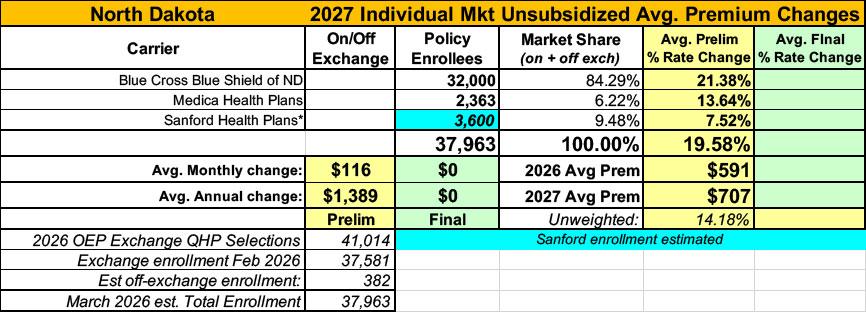
Looking ahead to 2027, the preliminary rate filings for both the individual and small group markets are now available via the federal Rate Review database:
Blue Cross Blue Shield of ND
Beginning 1/1/2027, members currently enrolled in various BCBSND Individual QHP’s will receive an adjustment to premiums exceeding 15% annually and requiring consumer disclosure. The average increase across all plans is 21.4%, but specific premium adjustments will vary by age, tobacco usage status, and individual plan selections. This adjustment will affect approximately 32,000 members.
Financial Experience
For policy year 2025, premiums received were sufficient to cover claims paid, administrative costs, commissions, taxes, and fees. The rate adjustment effective January 1, 2027, is intended to cover future changes in medical/pharmacy expenses, state-based reinsurance pool modifications, population morbidity changes due to expiring enhanced premium tax credits, administrative costs, taxes and fees, and profit/risk margin.
Under Medical Loss Ratio (MLR) requirements, the ACA requires Individual products to pay at least 80 cents of every premium dollar (after taxes and fees) toward medical/pharmacy claims and other qualified expenses. BCBSND significantly exceeds this requirement, expecting to pay approximately 90% of net premium dollars for 2027 Individual QHP’s towards qualified MLR expenses. If, in 2027, paid claims are significantly less than anticipated, rebates will be paid to Individual QHP members. Changes in Medical/Pharmacy Costs, Benefits, and Administrative Expenses BCBSND is expecting notable increases in Medical/Pharmacy expenditures and other cost drivers in 2026/2027 due to the following factors:
- Increased reimbursement rates for physicians & hospital systems that provide care to members • Surging utilization and intensity of outpatient medical procedures and services
- Growing utilization and cost of pharmaceuticals, especially GLP/GIP-1 Weight-Loss drugs which have notably increased costs since their addition to North Dakotas Essential Health Benchmark
- Changing cost-shares such as deductibles and copayments
- Expected deterioration of the North Dakota Individual markets overall health status, due to population changes related to the expiration of enhanced premium tax credits (eAPTC’s)
- Significant changes to North Dakota’s state-based reinsurance program parameters for 2027 reducing the level of premium subsidization it brings to the individual marketplace
Medica Health Plans
Medica Health Plans (MHP) is requesting a rate change for its Affordable Care Act (ACA) individual market business in North Dakota. The rate change will take effect on January 1, 2027 and will impact an estimated 2,363 members. The average rate change will be 13.64% and will result in rate changes that vary across plan designs. This includes changes to the costs of care.
MHP uses 2025 data from North Dakota to develop premium rates. This data includes estimates of changes to the below through 2027:
- Population Medica expects to insure
- Cost of medical services
- Cost of pharmacy services
- Taxes and fees
The significant factors that impact the rate change include those listed above. Claim costs per member per month are expected to change from $485.81 in 2025 to $603.75in 2027.
2) Financial Experience of the Product
In 2025, 93.35% of premium dollars went towards medical services. Under the ACA, individual products are required to pay at least 80% of premium dollars, after taxes and fees are removed, toward medical services. For 2027, MHP is expecting that 84.47% of premium dollars will be spent on medical services.
3) Changes in Medical Service Costs
Medical cost changes, in both number of services and costs of services, make up the largest increase to MHP’s premium rates. Additionally, impacts due to better rates with hospitals and doctors and reviewing recent experience also aid in determining premium changes. Finally, relationships with providers are helping to improve premium rates through a lower overall cost for care.
4) Changes in Benefits MHP updates the plan designs offered each year, which impacts each plan’s cost-sharing (e.g. deductibles, copayments, etc.). These updates follow federal rules for how much of costs the insurance company will cover under that plan. Because these updates will be different for each plan, the rate changes will also be different by plan.
5) Administrative Costs and Anticipated Margins: MHP expects the cost to administer coverage per member per month (PMPM) for 2027 to be $77.00, which is higher than the 2026 value of $68.20. The main drivers of MHP’s administrative expenses are employee salaries and benefits, agent commissions, claim processing/IT, and clinical/network services.
Sanford Health Plans
(unfortunately, Sanford's actuarial memo is heavily redacted which also means I don't have a hard enrollment number for them, but I'm estimating it to be around 3,600 people based on the official February on-exchange effectuated enrollment number from the Centers for Medicare & Medicaid Services (CMS), assuming a small number of off-exchange enrollees as well.
Assuming my estimate for Sanford is accurate, the weighted average rate hike being requested by North Dakota carriers is 19.6%.
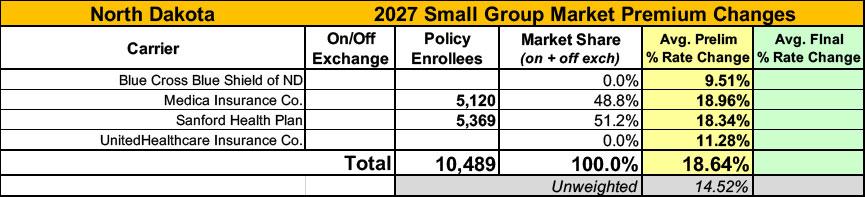
As for the North Dakota small group market, there are four carriers asking for an unweighted average rate increase of 14.5% (filings for two of the four are redacted, preventing a weighted average from being run):
Advertisement


