


2027 Rate Changes - New Mexico: +24.4% indy mkt (FINAL), +20.2% sm. group (prelim)
Fri, 09/04/2026 - 3:41pm
Originally posted 08/13/2026
Thanks to New Mexico backfilling 100% of ALL lost federal tax credits for EVERY ACA exchange enrollee in the state who was eligible for subsidies last year, their average monthly enrollment total is actually higher than it was in 2025 in spite of Congressional Republicans allowing the enhanced federal subsidies to expire at the end of 2025. Initial signups during Open Enrollment were actually up a whopping 18% vs. OEP 2025.
Even so, effectuated enrollment has still gradually declined over the course of the year so far...from 15% higher year over year in January to just 0.5% higher as of July...and this month it actually slipped slightly below the August 2025 tally (New Mexico is one of a handful of states which provide timely, monthly effectuated enrollment data reports).
The monthly average is still 6.5% higher than it was through August of last year, but I could see this drifting down to just 1-2% higher, or roughly even year over year by December.
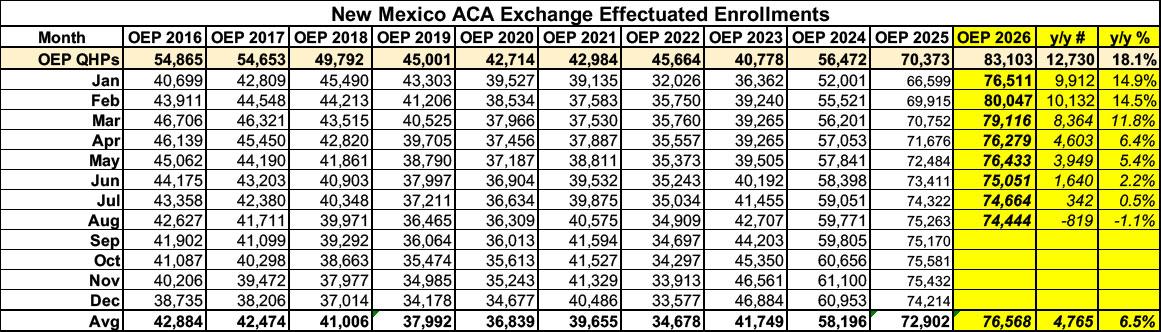
Here's what this looks like visually, with both 2025 and 2019 (the last pre-COVID year, which didn't include the enhanced subsidies) included for comparison:

Looking ahead to 2027, the preliminary rate filings for both the individual and small group markets are now available via the federal Rate Review database:
Blue Cross Blue Shield of NM (Health Care Service Corp):
Blue Cross and Blue Shield of New Mexico (BCBSNM) is filing new rates to be effective January 1, 2027, for its Individual ACA metallic coverage. As measured in the Unified Rate Review Template (URRT), the range of rate changes for these plans is an increase of 27.4% to an increase of 33.1%. The following is the average rate increase:
Product Rate Increase: Blue Community 29.05%
The cost relativities among plans are different from the experience period to the prospective rating period due to anticipated non-uniform changes in network reimbursement levels. Additionally, the rates vary by plan due to the leveraging and utilization differences driven by variations in member cost sharing. Therefore, the proposed rates and rate changes may vary by plan. Changes in allowable rating factors, such as age and geographical area, may also impact the premium amount for the coverage.
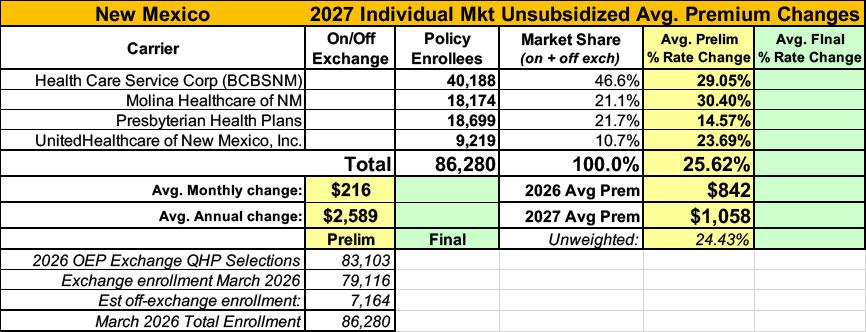
There are currently 40,188 members on Individual Affordable Care Act (ACA) plans that may be affected by these proposed rates.
Financial Experience of the Product
Consistent with the filed URRT, earned premiums for Individual plans during calendar year 2025 were $270,562,976 and total claims incurred were $310,362,719. The proposed rates effective January 1, 2027, are expected to achieve the loss ratio assumed in the rate development.
Changes in Medical Service Costs
The proposed rates reflect expected change in year over year medical service and prescription drug costs, which includes changes in reimbursement rates to providers, changes in expected utilization of services, the mix and intensity of services, and the introduction of new procedures and technologies.
Changes in Benefits
Cost-sharing changes were made within these products allowing plans to maintain their metal status and to comply with 2027 Plan Year Standardized Health Plan requirements prescribed by the BeWell Board of Directors, which can contribute to the change in rates.
State Mandated Changes
The proposed rates reflect the impact of New Mexico legislation items and/or regulatory changes effective on January 1, 2027. In accordance with state regulation, we have applied a CSR defunding adjustment to on-Exchange silver plans which reflects the expected cost and mix of enrollment in CSR plan variants and excludes health status.
Plan offerings comply with 2027 Plan Year Individual QHP and Small Group Market Rate Filing Guidance to set the tobacco rating multiplier at 1.0 for all individual on-and-off-exchange plans, offer only two on-exchange non-standardized Silver and Gold plans in any rating area, and keep the minimum premium differential for a 21-year-old between any two non-standardized silver plans in a single area above $10 PMPM.
In addition, Turquoise variants are made available for each Silver and Gold plan with Turquoise 3 eligibility to 200-400% FPL and the -13 variant for Native Americans between 300-400% FPL and participate in Gold plans, as mandated by the Health Insurance Marketplace Affordability Program Policy and Procedures Manual.
Administrative Costs and Anticipated Margins
The Affordable Care Act expects health plans in the individual market to spend at least 80% of each premium dollar they collect to pay for medical care and activities that improve health care quality for members. If health plans fail to spend at least 80% on medical claims and health care quality initiatives, they are required to give back money to consumers through a premium rebate. These rates assume BCBSNM will once again exceed the 80% threshold.
Molina Healthcare of NM:
Molina Healthcare of New Mexico, Inc. is a managed care organization that provides healthcare services to individuals eligible for Medicaid, Medicare, and Marketplace throughout the State of New Mexico. Molina Healthcare of New Mexico, Inc. is a licensed state health plan managed by its parent corporation, Molina Healthcare, Inc.
1. Scope and range of the rate increase: Molina’s proposed rates represent an average rate increase of 30.4% for the 18,174 Molina members enrolled in continuing plans effective March 2026. The proposed rate changes vary by metal tier. Members would receive premium increases of approximately 30.4% depending on their geographic location, metal tier, and age.
2. Financial experience of the product: The proposed premium rates yield a medical loss ratio of 87.3%. The medical loss ratio represents the percentage of every premium dollar that Molina expects to spend on medical expenses and improving health care quality for our members. The projected medical loss ratio of 87.3% exceeds the Affordable Care Act minimum required loss ratio of 80.0%.
3. Changes in Medical Service Costs: Medical inflation related to the utilization and cost of covered services increased claims by 10.2%. Trend is one of the primary contributors to an increase in rates. Changes in provider contracting rates also contributes to the regional rate changes.
4. Changes in Benefits: Molina is renewing 2 gold and 1 silver plan offering from 2026, and introducing one new silver plan and one new bronze plan offering. Benefit changes by plan are summarized below for renewing plans with projected membership in PY2027.
The Turquoise 1 variant of the Clear Cost Silver plan design’s individual calendar year maximum out of pocket is increasing from $250 to $300. Additionally, copays on Specialist visits, laboratory services, imaging and skilled nursing facility are increasing from $3 to $5. Copays on outpatient facility services are increasing from $5 to $10. Copays on all inpatient hospital services and emergency room services are increasing from $30 to $35.
The Turquoise 2 variant of the Clear Cost Silver plan design’s individual calendar year deductible and maximum out of pocket amounts are increasing from $200 to $400 and from $1,200 to $1,400, respectively. Additionally, copays on primary care visits are increasing from $5 to $10. Copays on Specialist visits, laboratory services, imaging and skilled nursing facility are increasing from $10 to $20. Copays on outpatient facility services are increasing from $35 to $45. Copays on all inpatient hospital services and emergency room services are increasing from $40 to $55. Prescription copays are increasing from $3 to $10 for generic, $10 to $20 for preferred brand, and $50 to $55 for non-preferred brand drugs.
The Turquoise 3 variant of the Clear Cost Gold plan design’s individual calendar year deductible and maximum out of pocket amounts are increasing from $700 to $1,350 and from $2,800 to $3,600, 1respectively. Additionally, copays on primary care visits are increasing from $7 to $15. Copays on Specialist visits, laboratory services, imaging and skilled nursing facility are increasing from $20 to $30. Copays on outpatient facility services are increasing from $60 to $90. Copays on all inpatient hospital services and emergency room services are increasing from $75 to $100. Prescription copays are increasing from $5 to $15 on generics and $10 to $30 on preferred brand drugs.
The Clear Cost Gold plan design’s individual calendar year deductible and maximum out of pocket amounts are increasing from $3,000 to $3,850 and from $6,000 to $6,850, respectively. No other cost sharing is changing for this plan.
The Turquoise 3 variant of the Molina Gold Low Cost Generic Rx plan design’s individual calendar year deductible and maximum out of pocket amounts are increasing from $500 to $900 and from $3,000 to $4,000, respectively. Additionally, copays on Specialist visits are increasing from $25 to $30, copays on urgent care visits are increasing from $10 to $20 and copays on speech, occupational, and physical therapy are increasing from $10 to $30. The copays, after deductible, on preferred brand and non-preferred generic drugs are decreasing from $35 to $25. Default coinsurance on medical services subject to coinsurance is increasing from 10% to 25%. Coinsurance levels on preferred specialty drugs, non-preferred brand drugs and non-preferred specialty drugs are increasing from 15% to 40%, 18% to 30%, and 20% to 50%, respectively.
The Molina Gold Low Cost Generic Rx plan design’s individual calendar year deductible and maximum out of pocket amounts are not changing. Copays on urgent care visits are increasing from $20 to $40 and copays on speech, occupational, and physical therapy are increasing from $20 to $50. The copay on preferred generic drugs is decreasing from $15 to $10. Coinsurance levels on preferred specialty drugs, non-preferred brand drugs and non-preferred specialty drugs are increasing from 25% to 40%, 28% to 35%, and 30% to 50%, respectively.
Benefit changes were implemented to comply with allowable actuarial value ranges by metallic offering using the PY2027 federal actuarial value calculator. The increases in member cost sharing serve to reduce the plan actuarial values used in pricing, putting downward pressure on rates and dampening the overall rate change. The newly offered Molina Silver Low Cost Generic Rx and Molina Bronzer Saver plans also offer lower actuarial value, lower relative premium options in the market.
5. Administrative Costs and Anticipated Profits: Total administrative expenses are expected to increase compared to 2026, contributing to a increase in rates of approximately 3.8%, primarily due to an increase in per member per month corporate expense. Targeted profit margin remains the same as the prior year’s rate filing.
Presbyterian Health Plans:
Presbyterian Health Plan (PHP) is filing rates for the Individual block of business, effective 1/1/2027. This document is submitted in conjunction with the Part I Unified Rate Review Template and the Part III Actuarial Memorandum. This information is intended for use by the New Mexico Office of the Superintendent of Insurance (OSI), the Center for Consumer Information and Insurance Oversight (CCIIO), and health insurance consumers in order to assist in the review of PHP’s Individual rate filing. This information may not be appropriate for other purposes. Milliman makes no representations or warranties regarding the contents of this letter to other users. Likewise, other users of this letter should not place reliance upon this actuarial memorandum that would result in the creation of any duty or liability for Milliman under any theory of law.
The results are actuarial projections. Actual experience will differ for a number of reasons, including population changes, claims experience, and random deviations from assumptions.
We have calculated an overall rate change of 14.6% from the rates effective 1/1/2026 to the rates effective 1/1/2027. In pricing Individual products for 2027, we have updated underlying experience for the latest experience of the single risk pool (CY2025), updated projected rebates received for prescription drugs, updated administrative expense projections, updated assumptions for federal risk adjustment, updated network savings, and provider reimbursement information. All of these factors contribute to the premium rate change. The proposed rate change of 14.6% applies to approximately 18,699 individuals as of March 2026. Actual increases for any particular contract holder will vary based on plan and network.
In 2025, earned premium was $617.15 per member per month (PMPM). Incurred claims in 2025 after accounting for rebates and the state SOPA payment were $617.25, or 100.0% of premium. After adjusting for risk adjustment, the estimated 2025 claim-to-premium ratio was 100.9%. Differences between the underlying 2025 claims cost (before rebates, utilization management, and SOPA payments) compared to the experience projected for 2025 in the 2026 rate filing account for 10.9% of the overall rate increase.
Medical trend, or the increase in health care costs over time, is composed of two components: the increase in the unit cost of services and the increase in the utilization of those services. Unit cost increases occur as care providers and their suppliers raise their prices. Utilization increases can occur as people seek more services than before. Additionally, simple services can be replaced with more complex services over time, which is known as service intensity trend. An example of service intensity trend would be the replacement of an X-ray with an MRI scan. Replacing the service with a more intense service causes the total cost of medical services to increase. An additional year of total trend from 2026 to 2027 accounts for approximately 9.0% of the overall rate increase.
In addition to the above,
1) Presbyterian administrative cost allocated to the individual product has increased in the 2027 filing relative to the 2026 filing. This is driven by changes in the membership mix across products resulting in reallocation of fixed costs from other products to the individual product.
2) Presbyterian had implemented several programs intended to reduce utilization and lower costs in 2025 that were incorporated into the 2026 filing but has fewer programs in place projected to result in savings for 2026 and 2027. Together, these contribute toward a 0.8% increase in premium relative to what was assumed for the 2026 filing.
3) Presbyterian’s risk adjustment transfer in 2025 is projected to be a smaller payable compared to what was 2024. The 2027 filing starts from the 2025 risk adjustment as the basis for the projection, resulting in a lower projected risk adjustment transfer payable. This results in a decrease in premium of 0.9%.
4) Presbyterian is changing benefits and network for plans in 2027 and is expected to have different mix of members, resulting in a decrease in premium of 9.4%. The projected loss ratio is 83.7% after accounting for taxes and fees, which satisfies the federal minimum loss ratio requirement of 80.0%.
UnitedHealthcare of NM, Inc:
UHCNM is filing 2027 rates for individual products. The proposed rate change is 23.69% and will affect 9,219 individuals. The rate changes vary between 11.45% and 32.28%. Given that the rate changes are based on the same single risk pool, the rate changes vary by plan due to plan design changes.
Financial Experience of the Product
The premium collected in plan year 2025 was $110,914,474. Incurred claims during this period were $135,398,739 and UHCNM expects payments of $2,966,941 for risk adjustment. The loss ratio, or portion of premium required to pay medical claims, for plan year 2025 is 124.75%.
Changes in Medical Service Costs
There are many different healthcare cost trends that contribute to increases in the overall U.S. healthcare spending each year. These trend factors affect health insurance premiums, which can mean a premium rate increase to cover costs. Some of the key healthcare cost trends that have affected this year’s rate actions include:
- Increasing cost of medical services [3.2%]: Annual increases in reimbursement rates to healthcare providers, such as hospitals, doctors, and pharmaceutical companies.
- Increased utilization [7.5%]: The number of office visits and other services continues to grow. In addition, total healthcare spending will vary by the intensity of care and use of different types of health services. The price of care can be affected using expensive procedures such as surgery versus simply monitoring or providing medications.
- Higher costs from deductible leveraging: Healthcare costs continue to rise every year. If deductibles and copayments remain the same, a higher percentage of healthcare costs need to be covered by health insurance premiums each year.
- Impact of new technology: Improvements to medical technology and clinical practice often result in the use of more expensive services, leading to increased healthcare spending and utilization.
Changes in Benefits
Changes in benefits impact costs and therefore affect premium changes. Plan benefits are typically changed for one of three reasons: to comply with the requirements of the Affordable Care Act or state law, to respond to consumer feedback, or to address a particular medical cost issue to provide greater long-term affordability of the product.
The Affordable Care Act implemented requirements for the “value” that must be offered by plan designs in the Individual and Small Group markets. These are called “metal levels.” For a benefit plan to remain classified within a particular metal level from year to year, adjustments to deductibles, copayments or coinsurance are sometimes required. These adjustments impact the cost and therefore the premium increases for the plan.
Administrative Costs and Anticipated Margins
UHCNM works to directly control administrative expenses by adopting better processes and technology and developing programs and innovations that make healthcare more affordable. We have led the marketplace by introducing key innovations that make healthcare services more accessible and affordable for customers, improve the quality and coordination of healthcare services, and help individuals and their physicians make more informed healthcare decisions.
Taxes and fees imposed by the state and federal government are significant factors that impact healthcare spending and must be included as additional administrative costs associated with the plans. These fees include Affordable Care Act taxes and fees which impact health insurance costs and need to be reflected in premium. Another component of premium is margin, which is set to address expected volatility and risk in the market.
The requested rate change is anticipated to be sufficient to cover the projected benefit and administrative costs for the 2027 plan year.
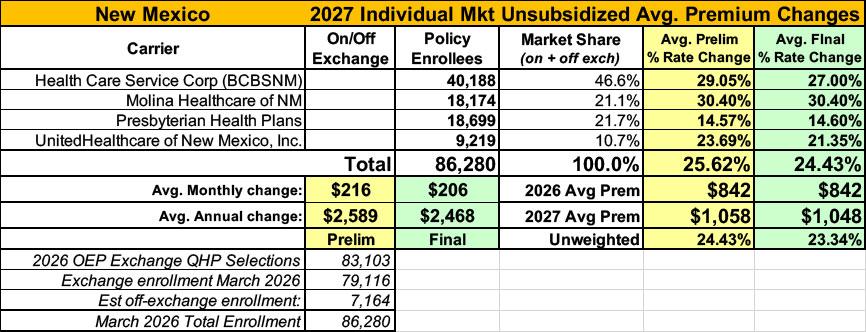
Combined, the four New Mexico carriers are asking for premium increases averaging a whopping 25.6% for 2027...pushing the average for unsubsidized enrollees up to over $1,000/month:
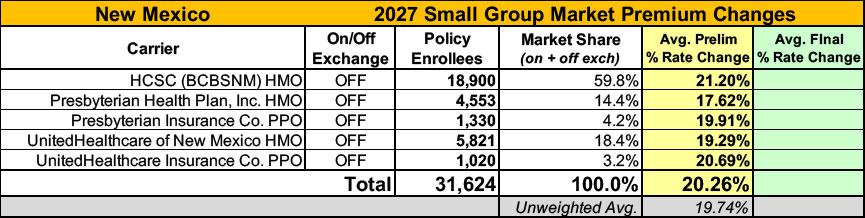
Meanwhile, the New Mexico small group market is looking at an average rate increase of 20.2%:
UPDATE 9/4/26: Via the New Mexico Office of Superintendent of Insurance:
SANTA FE, N.M. – The New Mexico Office of Superintendent of Insurance (OSI) has approved 2027 rates for individual market Affordable Care Act (ACA) plans sold on and off BeWell, the New Mexico Health Insurance Marketplace. The average increase is 24.4%; OSI scrutinized the rates and they are actuarially sound, as required by federal and state laws.
“Rising health care costs and inflation are continuing to affect consumers nationwide and New Mexico is no different. Despite the rate increase, I can assure you that the rates for all the insurance companies are actuarially sound, non-discriminatory, and transparent,” said Superintendent of Insurance Alice Kane.
The rate increase is higher than the nationwide median of 15%. New Mexico’s premiums, however, have historically been lower than most other states. The rate increase and historically lower premiums result in premiums that are now in line with the rest of the nation before subsidy assistance. It is important to note that 92% of BeWell enrollees are eligible for state and federal premium subsidies based on income.
New Mexico’s Health Care Affordability Fund (HCAF) will continue to provide financial assistance to eligible New Mexicans. In 2027, the HCAF is expected to provide ongoing premium and cost-sharing relief for BeWell enrollees, helping to mitigate the impact of the rate increase. Federal and state premium assistance will continue to play a significant role in safeguarding the affordability of health insurance.
Our state’s uniquely comprehensive benefits such as behavioral health services and prior authorization prohibitions contribute to the rate increases. Insurance companies cannot charge cost-sharing for in-network behavioral health services or require prior authorization for certain behavioral health services. Removing cost-sharing and prior authorization requirements promotes utilization, which initially increases premiums but will save costs and improve overall health outcomes in the long-term.
The key factors that contributed to the rate increase this year include:
- Higher than expected 2025 New Mexico claims experience, which is the foundation for the 2027 rate development;
- Higher utilization and inflation impacted healthcare costs services, which impacts medical services and pharmaceutical costs nationwide; and
- Upward trending of brand name drugs and biologicals, which often provide advanced therapies, comprised 85% of overall drugs costs in New Mexico.
Turquoise Plans continue to provide additional savings on deductibles and co-pays. Standardized “Clear Cost” plans also continue to be offered and feature consistent costsharing structures, regardless of the insurance company, making it easier for BeWell enrollees to compare plans.
During the open enrollment period from November 1 to January 15, BeWell enrollees can schedule an appointment at bewellnm.com/appointment and have a certified assister guide them through finding a plan that is right for their needs.
BeWell Resources:
- Visit www.bewellnm.com November 1 to compare plans and prices.
- Be on the lookout for your BeWell renewal letter at the start of Open Enrollment.
- Make sure your income information is up to date and report any changes throughout the year as soon as possible.
- Call 833-862-3935 to speak to someone or make an appointment at bewellnm.com/appointment.
The rates take effect on January 1, 2027. The insurance companies offering coverage in New Mexico will remain the same: Health Care Service Corporation (dba BCBS NM), Presbyterian Health Plan, United Healthcare of New Mexico, and Molina Health Care of New Mexico.
Unfortunately the NM OSI hasn't posted final/approved 2027 rates for the small group market yet, but I'll update this post again when those come out.
Advertisement


