


2027 Rate Changes - Colorado: +10% (or +12.8%?) indy market; +8.6% sm. group (FINAL)
Wed, 09/23/2026 - 10:14am
Originally posted 7/28/26
Before I begin, it's important to note that ACA exchange enrollment has dropped in Colorado since Congressional Republicans allowed the enhanced federal subsidies to expire at the end of last year...although thanks to the state implementing fairly robust supplemental subsidies of their own along with (modest) Premium Alignment pricing, it's not nearly as dramatic a drop-off as in most other states.
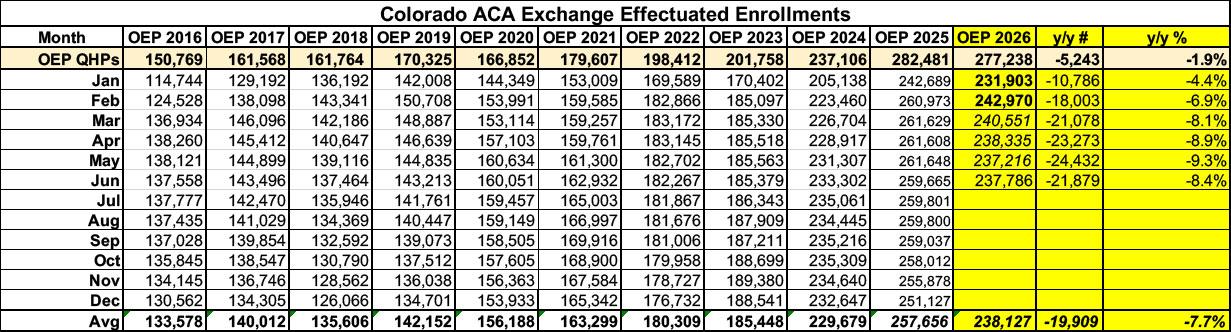
Initial signups during Open Enrollment were only down about 2% vs. 2025..but effectuated enrollment began to drop immediately and has continued to drop every month since then.
As of June 2026, effectuated enrollment is down 8.4% vs. a year earlier, and is down 7.7% on average for the year so far. That's around 22,000 fewer Coloradans with ACA exchange coverage so far this year:
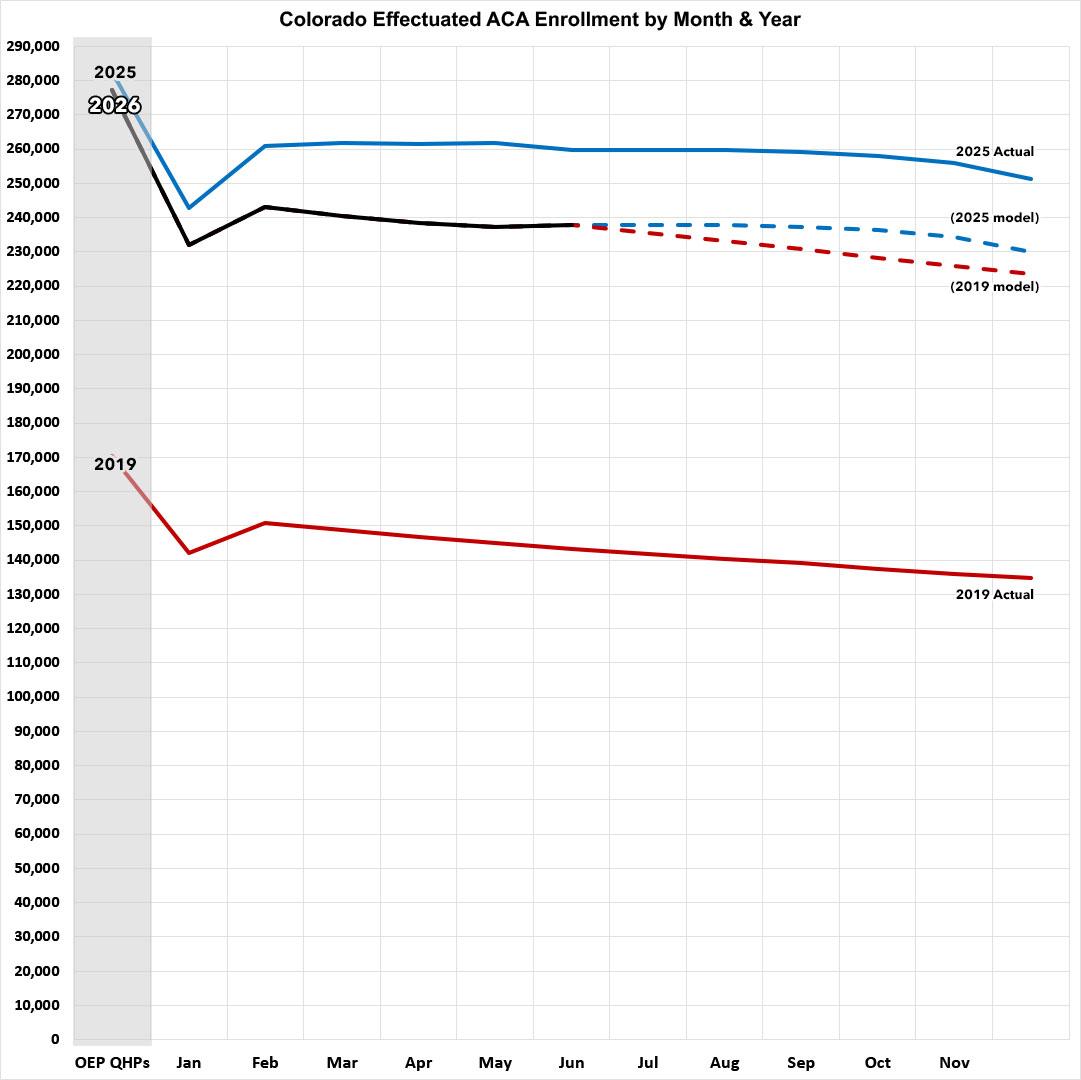
Here's what this looks like visually, with both 2025 and 2019 (the last pre-COVID year, which didn't include the enhanced subsidies) included for comparison:
Looking ahead to 2027, the preliminary rate filings for both the individual and small group markets have been published by the Colorado Insurance Department:
ACA Health Insurance Premiums for Individuals Expected to Increase by 11% in 2027
- Colorado Premium Assistance will continue to be available to those who qualify, and continue to reduce rate increases
DENVER — The Colorado Division of Insurance (DOI), part of the Department of Regulatory Agencies (DORA), today released the preliminary information on private health insurance plans for 2027 for the individual market, which serves Coloradans who do not receive coverage through an employer, as well as the small and large group markets for employers that purchase coverage for employees through the marketplace. The filings can be found on DOI’s webpage.
For individuals enrolled in Colorado’s individual market, rates are expected to increase by an average of 11%, less than the national increase. These rates are based only on what the insurance companies have requested, not what has been approved. Over the next month, the DOI will conduct in-depth analyses of every company’s filings to ensure that the requested premiums can be justified.
The strange thing is (as you can see in the first table below), the actual weighted average increase comes in at 13.4% even though the press release says it only averages 11%. Also, as of this writing, the filings themselves aren't posted on the DOI webpage that the press release links to...I had to find them via the Colorado SERFF database directly. Huh.
“Americans are sick and tired of getting ripped off on healthcare. We need major reform at the national level including paying the same amount for prescription drugs as Europe and Canada do,” said Governor Jared Polis.
“Unfortunately, we continually warned that Congress’ failure to extend the enhanced premium tax credits would lead to instability in the market, and that’s a significant part of why we are continuing to see rate increases,” said Colorado Insurance Commissioner Michael Conway. “At the state level, we worked to provide premium assistance to Coloradans struggling to afford their premiums, and because of that, Colorado is doing better than other states at keeping people insured. If you’re purchasing a health insurance plan this fall through Connect for Health Colorado, we encourage you to work with your broker or shop around to find the plan that works best for you and your family.”
Rate increases can partially be attributed to Congress’ failure to extend the federal enhanced premium tax credits (ePTCs) last year, which had lowered costs to Americans since 2021. Expiration of ePTCs in Colorado resulted in a doubling of premium costs on average for hundreds of thousands of Coloradans in the individual market for the 2026 plan year. The instability caused by Congress’ lack of action continues to have ripple effects, with Cigna leaving the individual market nationwide for the upcoming plan year, and with continued rate increases.
As of late July, about one third of states have published their proposed individual market premium increases for 2027, with a median rate increase of about 14%. Colorado acted during the August 2025 special session to prevent the federal cuts from causing even greater increases in health care costs and, as a result, is faring better than other states. Governor Polis signed HB25B-1006, which directed additional funding to Colorado’s Reinsurance and Colorado Premium Assistance (CPA) programs for qualifying households earning between 100% and 400% of the federal poverty line. In addition, SB26-178 was signed into law by Governor Polis this year to continue to provide relief to Coloradans through Reinsurance and CPA.
Nationally, ACA Individual Market enrollment has dropped 13% this plan year. By comparison, as of February of this year, Colorado’s drop in enrollment was only 5%, showing that HB25B-1006 has helped keep more people enrolled.
Colorado’s marketplace also continues to be competitive. Open Enrollment will begin on November 1, 2026, with a new carrier in the individual market, Colorado Access.
As I noted above, the actual filings themselves come in with a weighted preliminary 2027 rate increase of 13.4%, ranging between 10.2% and 23.9% depending on the carrier. As noted in the press release, Cigna Health & Life Insurance Co. is dropping out of ACA exchanges nationally, which means around 41,000 Coloradans will have to shop around for plans from another carrier.

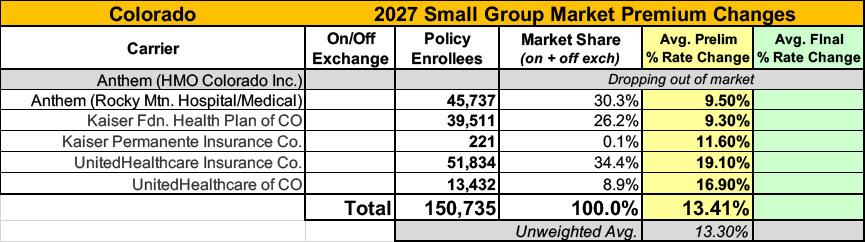
Meanwhile, Colorado's small group market carriers are also looking at a similar 13.4% rate increase next year, with HMO Colorado apparently also pulling out of the state (at the very least they haven't published a 2027 filing for the small group market yet, anyway):
UPDATE: Hmmm...the Colorado Dept. of Regulatory Agencies has posted a press release which lists the final/approved 2027 average rate increase for individual market plans as being 10%...which doesn't line up with the actual rate filings via the SERFF database at all:
DENVER - The Colorado Division of Insurance (DOI), part of the Department of Regulatory Agencies (DORA), today released the final approved premium information on private health insurance plans for 2027 for the individual market, which serves Coloradans who do not receive coverage through an employer, as well as the small group market, for small businesses that purchase coverage for employees. Premiums in Colorado will increase, on average, 10% in the individual market, compared to the 15% national median.
As you can see in my own table below, the weighted average increase according to the actual approved filings comes in at around 12.8%, not 10%. The unweighted average is even higher, at 15.5%. Hell, even if CO DORA is including Cigna's ~41,000 enrollees in the denominator (which they shouldn't do anyway) it would still only reduce the average to ~11%. Weird.
An important part of DOI’s work is to review submitted premium rate filings from insurance companies to ensure they comply with state and federal laws and to protect consumers from excessive or unfair premiums. For Plan Year 2027, the Division of Insurance saved Colorado consumers $42,136,281 on their premiums through the rate review process. Despite health insurance premium increases this year, Colorado is faring better than other states. Premium increases are lower in Colorado than the median across all states.
“While Congress is pulling the rug out from under millions of Americans struggling to afford healthcare, Colorado is stepping up to save people money. We’re slowing insurance rate increases in the private market well below the national average and saving Coloradans millions of dollars and keeping the individual market from ballooning in a way that would hurt employers, employees and Coloradans seeking insurance in the private market,” said Governor Polis.
“Where Congress has failed, Colorado is stepping up. Despite the loss of the enhanced premium tax credits, we are doing everything we can to keep health insurance prices down so Coloradans can afford access to health care. I want to thank our rate review team for all their hard work this filing season. Because of their diligence, we are saving Coloradans millions of dollars. But make no mistake: Congress still needs to restore the subsidies that millions of Americans relied on to afford their health insurance,” said Colorado Insurance Commissioner Michael Conway.
Premium increases can partially be attributed to Congress’ failure to extend the federal enhanced premium tax credits (ePTCs) last year, which had lowered costs to Americans since 2021. Expiration of ePTCs in Colorado resulted in a doubling of premium costs on average for hundreds of thousands of Coloradans in the individual market for the 2026 plan year and continues to cause instability.
Because Colorado took action during the August 2025 special session to prevent the federal cuts from causing even greater increases in health care costs, Colorado's enrollment drop this year is less than it is in many other states. To further protect Colorado consumers from steeper healthcare costs, Governor Polis signed SB26-178 into law earlier this year to continue to provide relief to Coloradans through Reinsurance and Colorado Premium Assistance (CPA). Thanks to CPA, financially assisted customers will see an estimated net premium increase of just $20 per month from 2026 to 2027. Without this support, increases would have been more than three times higher, averaging $69 per month.
Colorado’s marketplace continues to be competitive. Open Enrollment will begin on November 1, 2026, with a new carrier in the individual market, Colorado Access. Federal changes announced on September 22, 2026 regarding removing individuals from Affordable Care Act health insurance marketplaces don’t apply to Colorado which has its own state-based exchange. As consumers shop around, the Division wants to remind them of Colorado Option plans, which continue to provide plans with $0 primary care and mental health visits.

The confusion continues with the small group market: The CO DORA press release says that small group plans will be going up an average of 14%, but my math & the SERFF filings brings it in much lower, at just 8.6%:

I'll update this post if/when I resolve these discrepancies.
Advertisement


